TheNanjing University–University of Cambridge Global Humanities Collaborative Innovation Platform Enhancement Project, supported by the Nanjing University International Collaboration Initiative (NICI), presents a special visit from two renowned Cambridge medievalists—Professor Máire Ní Mhaonaigh and Professor Miranda Griffin.
FromSeptember 22 to 24, 2025, the Institute of Global Humanities at Nanjing University will host a series ofthree high-level academic events—two lectures and one workshop—exploring medieval manuscripts, literature, and the environment from fresh interdisciplinary perspectives.
[Speakers’ Profiles]
Máire Ní Mhaonaighis Professor of Celtic and Medieval Studies at the University of Cambridge and a Fellow of St John’s College. Her research focuses on the literature and history of Ireland, Britain and Scandinavia, and on contacts and connections between these regions and elsewhere in western Europe. A recent co-written volume is entitled Norse-Gaelic Contacts in a Viking World, and her current scholarship explores the landscape literature of medieval Ireland in particular.
Miranda Griffinis Professor of Medieval French Literature at the University of Cambridge, where she is a fellow of Murray Edwards College. Her research focuses on French literary culture from the twelfth to the fifteenth century. She is the author of The Object and the Cause in the Vulgate Cycle (on a story cycle about King Arthur and the Holy Grail) and Transforming Tales: Rewriting Metamorphosis in Medieval French Literature. She is currently working on a book about representations of landscape in medieval French narrative.
[Event Schedule]
Lecture I
Windows on the World: Some Medieval Manuscripts of Cambridge in Context
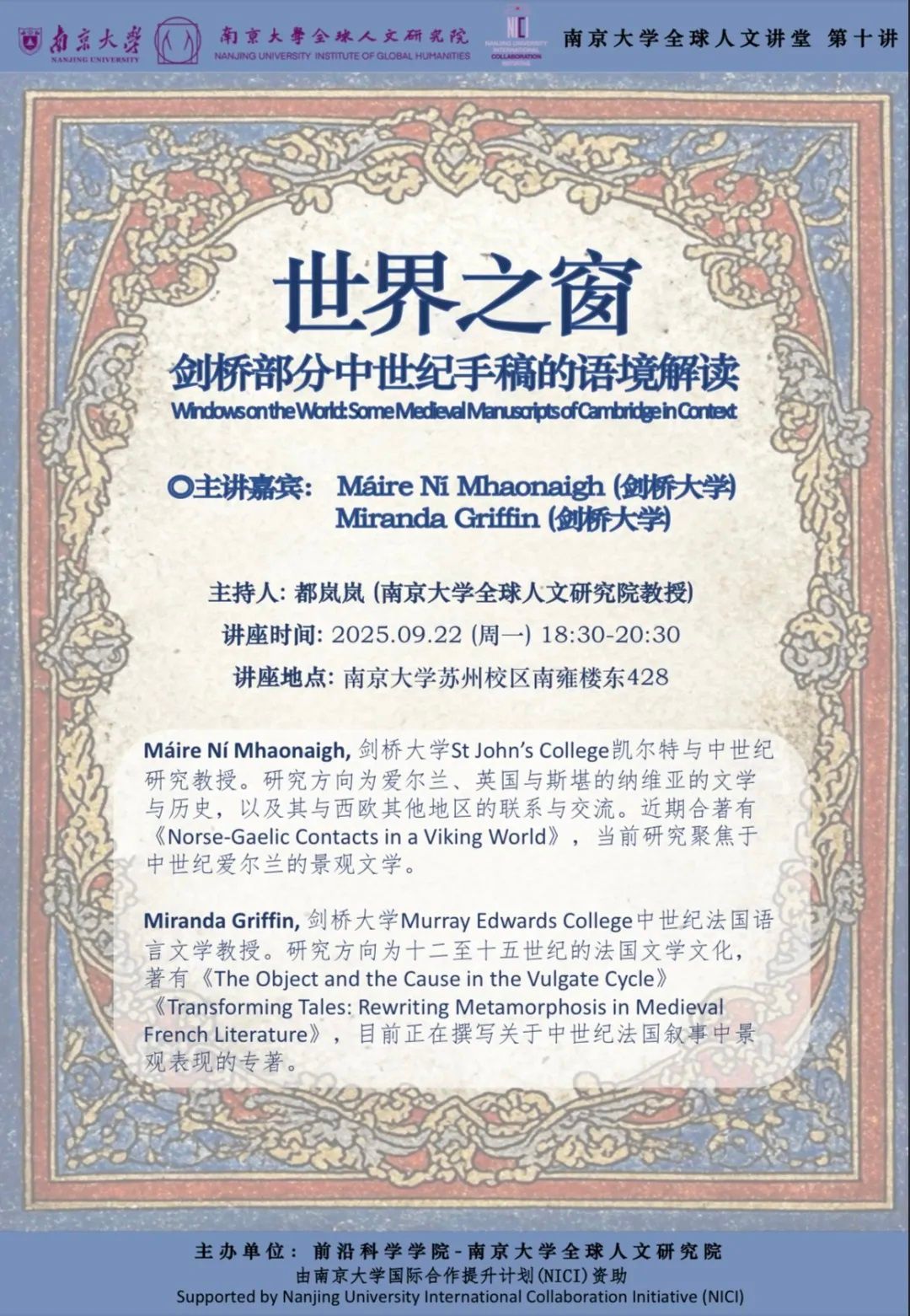
Speakers:Máire Ní Mhaonaigh, Miranda Griffin
Chair:Prof. Du Lanlan (Nanjing University)
Date & Time:Monday, September 22, 18:30–20:30
Venue:Room E428, Nanyong Building, Suzhou Campus
Abstract:The University of Cambridge holds a large number of medieval manuscripts both in the University Library and across the many libraries of its constituent Colleges, the earliest of which may be the fourth- or fifth-century bilingual Latin-Greek manuscript, the Codex Bezae. This manuscript is typical of many Cambridge manuscripts, though the nature of the languages in contact and the variety of content in these codices varies greatly. Focussing on two manuscripts in particular, we will illustrate how these objects can provide windows on all kinds of worlds. The story of how this illustrated manuscript made its way from Ireland to England, showing traces of its physical and intellectual journeys along the way is captured in its bilingual pages, as we will show, with reference to other comparable manuscripts. The second and latest of our case-studies will be Cambridge University Library Gg.1.1, a trilingual manuscript written in England containing Latin, English and French. A rich compendium of devotional, scientific, literary and historical texts, it is also richly illustrated, depicting literally and conceptually images of the world. Exploring these manuscripts and related works, we will discuss how scholars in the medieval west experienced and depicted windows on various worlds.
Lecture II
Stories in the Landscape: The Environment in Pre-Modern European Literature

Speakers:Máire Ní Mhaonaigh, Miranda Griffin
Chair:Prof. He Chengzhou (Nanjing University)
Date & Time:Wednesday, September 24, 19:00–21:00
Venue:Room 303, Qiaoyu Building, Xianlin Campus
Abstract:European Christian medieval authors and readers often represented the world as a book that had been written by the hand of God. Reading that book was a pious duty, leading to a deeper understanding of divine creation, always in the context of humanity’s flawed and partial ability to know and decode God’s plan. The literature of the European Middle Ages (from 500 to 1500 of the Common Era) represents the world’s diversity and humanity’s responsibility to it in a rich variety of ways. We focus in this lecture on the traditions of Irish and French literature, exploring the ways in which narratives become associated with specific environments, and how specific environments seem to call forth particular sorts of stories.
In the case of Ireland, an eleventh-/twelfth-century extensive written corpus depicts its history as an overarching narrative of place. Within this textual frame, human engagement with forests, rivers, mountains is presented in nuanced and varied ways. Political circumstances shape these stories, contemporary rulers projecting control of their surroundings into the distant past. In this way, the literary landscape is formed in the image of the ruling elite, for specific contemporary purposes, as an exploration of certain stories will show.
In the fourteenth-century story of Mélusine, a hybrid snake-fairy is celebrated as the ancestor of the French royal family and reinforcing their claim to the castle of Lusignan in western France. In a chronicle and a devotional Book of Hours commissioned by the brother of the King of France, Mélusine is strongly connected to the landscape of Lusignan.
These examples will show that rather than being a simple backdrop to human action, the environment in medieval European literature actively collaborates in the articulation of stories that will explain and sustain it. In terms of modern ecocritical theory, understanding the ‘storied world’ can be a powerful means of recognising and protecting the many strands of more-than-human life that are entwined in our ecology.
Academic Workshop
Dialogues Across Time: Humanities in Transition—from Tradition to the Future
Chair:Dr. Zhang Tianyi (Nanjing University)
Date & Time:Tuesday, September 23, 15:00–17:00
Venue:Room E428, Nanyong Building, Suzhou Campus
Agenda:
15:00–15:30 Keynote:Literature and the Environment in the Premodern Period: Challenges and Approaches
15:30–15:45 Prof. Dai Congrong:The Book of Kells in Finnegans Wake
15:45–16:00 Prof. He Chengzhou:Kun Opera and Jiangnan Gardens
16:00–16:15 Prof. Du Lanlan:Post-apocalyptic Narratives in Contemporary Canadian Climate Change Fiction
16:15–17:00 Open Discussion

Organizers
Institute of Global Humanities, Nanjing University– School of Frontier Science
School of Foreign Studies, Nanjing University– Center for Comparative Literature and Intercultural Studies
Funding Support
We warmly invite students, scholars, and members of the wider community to join us for this unique opportunity to engage in meaningful dialogues onhumanity, literature, and the environment across time.